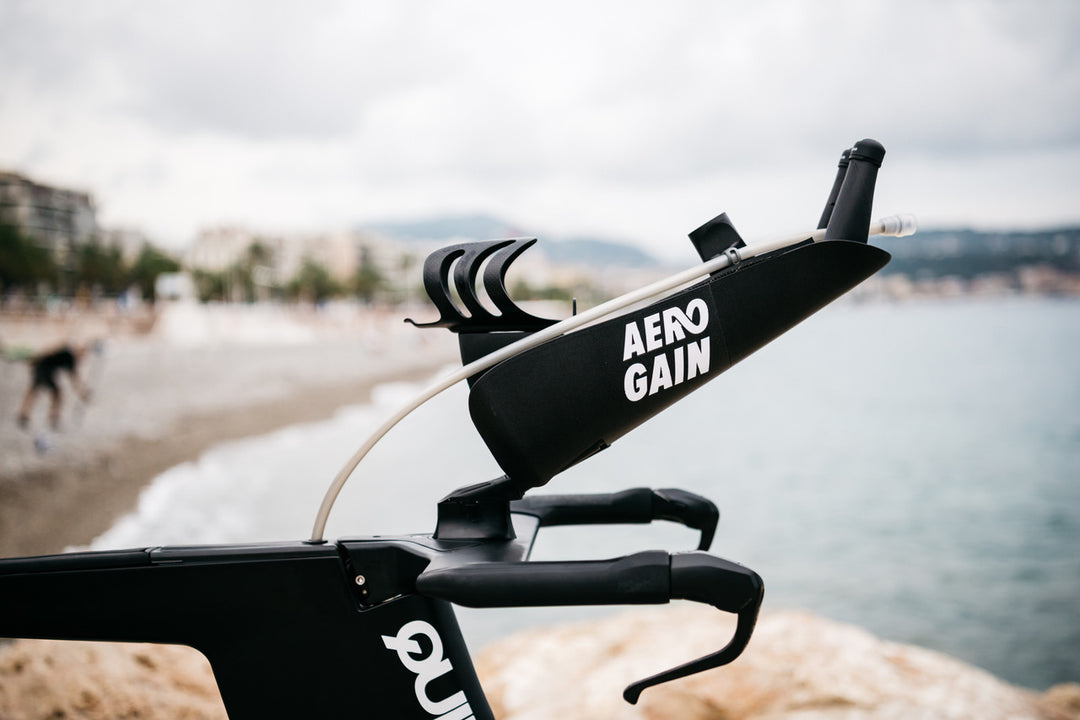

Aero BTA system
Aero BTA system
Aero BTA system
Aero BTA system
Aero BTA system
Aero BTA system
Aero BTA system
Aero BTA system
Aero BTA system
Aero BTA system
Aero BTA system
Aero BTA system

Aero BTA system

Front-bottle hydration that fills the dead air between your arms.

  • Median 8 W vs. riding with no bottles, 45 km/h, n=35 — 14 W best
  • Median 14 W swing off two frame bottles
  • Six spacer angles keep the bottle level
  • Three plate widths, fits most tri-bar cockpits
Regular price€169,90 EUR
/
VAT included

  • Free EU shipping over 200 EUR
  • Express worldwide shipping via FedEx — 1–5 days
  • 30-day satisfaction guarantee
  • In stock, ready to ship
  • Backordered, shipping soon
  • Express worldwide shipping with FedEx — 1–4 business days
  • 30-day returns
  • 2-year warranty
  • Crash replacement

Pairs well with

The numbers — velodrome-tested, not marketed

14 W

Median swing from two frame bottles to the BTA: stop paying 6 W, start collecting 8 W.

8 W

Median versus riding with no bottles at all, 35 athletes at 45 km/h. Best measured: 14 W.

6 angles

Angle-matched spacers from 0° to 30°, so the bottle sits level whatever your extensions do.

Nobody questions where the bottle goes

You’ll spend hundreds on a helmet chasing single-digit watts, then clip a cage to the down tube because that is where cages go. Two 750 ml frame bottles cost an average of 7 W at 45 km/h in our own velodrome testing, and 12 W at worst.

It’s not the bottle. It’s the gap it fills.

01 — The dead air

A pocket of separated, stalling air sits between your forearms and your chest. Aerodynamically, that pocket is expensive.

02 — Filling the gap

A bottle placed there fills it, so air is guided round your body instead of separating — and you can drink without leaving aero.

03 — Why the down tube does the opposite

The down tube already carries clean air between your legs. A bottle there makes an obstruction instead of filling one: an average of 7 W for two at 45 km/h.

The data

The whole test, not the flattering slice. 35 athletes, four bottle setups, one velodrome, measured at race speed.

Bar chart of power saved at 45 km/h versus riding with no bottles across four setups tested on 35 athletes at Ballerup Super Arena: two 750 ml bottles on the frame at minus 6 W median, single bottle between the arms at 4.5 W, double-bottle BTA at 8 W, and double-bottle BTA with the top bottle further back at 7.3 W
Power saved at 45 km/h versus riding with no bottles. Two 750 ml frame bottles cost a median of 6 W. A single bottle between the arms returns 4.5 W; a double-bottle BTA 8 W, and 7.3 W with the top bottle further back.
6 WTwo 750 ml frame bottles versus none. Average 7 W, worst 12 W.
8 WAero BTA versus no bottles. Best measured 14 W.
14 WFrame bottles to Aero BTA: stop paying 6 W, start collecting 8 W.
26 WWorst frame position plus best BTA result. The ceiling, not the expectation.
  • 35 athletes, Ballerup Super Arena velodrome, Copenhagen.
  • Test speeds 35–50 km/h, reported at 45 km/h.
  • Baseline CdA 0.165–0.237.
  • Medians: −6 W, 4.5 W, 8.0 W and 7.3 W, in the order shown.
  • Two frame bottles: average 7 W, median 6 W, worst measured 12 W.
  • Best measured Aero BTA result 14 W. Not all riders tested every setup.
  • Bars are group averages; whiskers the spread. Results vary with rider.

Aero BTA system

Front-bottle mount that sits in the gap between arms and chest, where the air is already stalling.

What you choose
Plate width — Medium 52–148 mm, Wide 148–198 mm, Extra Wide 198–238 mm. Spacer angle — 0°, 10°, 15°, 20°, 25°, 30°, matched to your extensions.

In the box
Base plate, spacer and bolts. Matte black. Takes one or two bottles, and mounts under your existing armrest pads with standard allen keys.

Built to sit exactly where the gap is

01 — Modular spacer system

Six spacer angles from 0° to 30° keep the bottle horizontal at any extension angle. Most one-piece mounts don’t adjust at all.

02 — Three width fits

Medium 52–148 mm, Wide 148–198 mm, Extra Wide above 198 mm. No filing parts down to fit.

03 — Integrated nose-cone

Leads airflow into the arm-chest gap instead of a blunt bottle face. Measurably less drag than our earlier design.

04 — Clamps to standard pad bridges

The base plate sits under your existing armrest pads. No extra brackets, no pad swap, one or two bottles.

Take two measurements before you order

Your extension angle and your armpad bridge width. Get both right and the bottle sits horizontal and centred.

1

Match your spacer to your extension angle

Match the spacer to the upward tilt of the whole assembly — mounting bracket and extensions together, not just the extension. Extensions level (0°) → the 0° spacer; tilted 20° → the 20° spacer; 30° → the 30° spacer.

Not sure? Rest your phone’s level app flat on your extensions to read the angle.

Technical line drawings of an AeroGain BTA mount carrying two bottles at 0, 20 and 30 degree extension angles, showing how a spacer matched to the extension angle keeps the bottles horizontal
Left: the assembly on the bike. Right: the matching spacer wedge. At 20° and 30° it cancels the tilt so the bottles stay horizontal.
2

Measure your armpad bridge width

Bolt centre to bolt centre, straight across: Medium 52–148 mm, Wide 148–198 mm, Extra Wide 198–238 mm.

Technical line drawing of a triathlon cockpit seen from above, with arrows marking the bolt-to-bolt distance across the armpad bridge that determines which AeroGain BTA mount plate size to order
Measure between the centres of the two mounting bolts. That one dimension decides your plate size.
How it mounts

Sandwiched under your armcups, which clamp it in place. No extra brackets, and no swapping your pads.

Plate width chart
FitBolt-to-bolt pad-bridge width
Medium52–148 mm
Wide148–198 mm
Extra Wide198–238 mm
Tools and install

Standard allen keys, a few minutes. Choose your plate width and spacer angle above before ordering.

This started as a bottle stuffed down a race suit

Discovered by accident, raced at the highest level, then banned. This is the legal successor.

2022

Founder Kristoffer Visti raced the Danish Nationals with a bottle down the front of his suit, and found the gain by accident.

Later that year

Magnus Ditlev used the same technique at the Ironman World Championship in Kona.

Early 2024

World Triathlon and Ironman banned it — for safety and uniformity, not aerodynamics.

The successor

Same principle, filling the arm-chest gap. Properly mounted, and velodrome-tested.

Built for tri-bar cockpits and riders who measure things

This is for you if

  • A TT or triathlon bike with a tri-bar cockpit and pad bridge.
  • You think in watts, not vibes.
  • Helmet and wheels sorted. You want the next real gain.
  • You want the mount to match your position, not the reverse.

This isn’t for you if

  • A road bike with no clip-ons and no pad bridge.
  • Two front bottles with fore-aft adjustment — see the Double Bottle BTA system V2.
  • Rear hydration and storage — that’s the Aero BTS PRO.
  • You don’t care about angle-matching.

Pad bridge, and you care about the number? Built for exactly that.

Fit and installation, answered

Three plate widths: Medium 52–148 mm, Wide 148–198 mm, Extra Wide above 198 mm. Measure bolt-to-bolt across your pad bridge — the chart is in the setup guide above.

Yes, if the clip-ons have a pad bridge to clamp onto. Not for road bikes without them.

Yes. For fore-aft adjustment on the second bottle, see the Double Bottle BTA system V2.

That’s what the spacers are for — 0° to 30° in six steps, matched to your whole extension assembly.

No. Standard allen keys, a few minutes. The plate goes under your existing pads.

Our own velodrome testing at Ballerup Super Arena, Copenhagen: 35 athletes, 35–50 km/h, reported at 45 km/h versus riding with no bottles. Not a single-rider tunnel run and not CFD. Median 8 W, best 14 W. Two frame bottles cost a median of 6 W, so switching is worth a median of 14 W.

30-day satisfaction guarantee on unused units in original condition and packaging. Confirm your pad-bridge width and extension angle first.

All aero figures from AeroGain in-house velodrome testing at Ballerup Super Arena, Copenhagen: 35 athletes, test speeds 35–50 km/h, baseline CdA 0.165–0.237, reported as power saved at 45 km/h versus riding with no bottles at all. Aero BTA median 8 W, best measured 14 W. Two 750 ml frame bottles cost an average of 7 W, a median of 6 W, worst measured 12 W — so switching is worth a median of 14 W, an average of 15 W, and 26 W in the best measured case. A single bottle between the arms returns a median of 4.5 W; a double with the top bottle further back, 7.3 W. Not all riders tested every setup. Individual results vary with rider position, bottle size and yaw. Test conditions available on request.

Velodrome-tested in Denmark

Stop losing watts to a bottle you never measured

Median 8 W versus riding with no bottles, 14 W at best — and a median 14 W swing if you are coming off two frame bottles. Six spacer angles, three plate widths.

Made and tested in Denmark · Express FedEx · 30-day satisfaction guarantee

Shop the Aero BTA system

You may also like