
The numbers — velodrome-tested, not marketed
14 W
Median gain from moving both bottles off the frame and into the cockpit: you stop paying 6 W and start collecting 8 W. On the averages it is 15 W, and 26 W in the best case we measured.
8 W
Median saving for the double-bottle BTA versus no bottles at all, with the top bottle forward between the arms. Best measured result 14 W; 7.3 W with the top bottle further back.
6 angles
Angle-matched spacers at 0°, 10°, 15°, 20°, 25° and 30°, so both bottles sit level whatever your extensions are doing.
Two bottles, and nobody asks where they go
A full-distance bike leg needs more fluid than one bottle carries. So the second bottle goes on the down tube, because that is just where cages go, and nobody measures what it costs.
The down tube sits in an otherwise clean airflow path between your legs. Two 750 ml bottles parked there cost an average of 7 W at 45 km/h in our own velodrome testing, and 12 W for the worst position we measured. Move both into the cockpit and the same test returns a median of 8 W. That is a median swing of 14 W for changing nothing but where the bottles sit.
It’s not the bottle. It’s the gap it fills.
01 — The dead air
In an aggressive aero position, a pocket of separated, turbulent air sits in the gap between your forearms and your chest. This is dead air — flow that has already detached from the body and is stalling instead of moving cleanly past it. Aerodynamically, that pocket is expensive.
02 — Filling the gap
Place a bottle between the arms, close to and parallel with the chest, and it fills that exact gap. Air that would otherwise separate and stall is guided smoothly around your whole body instead. The bottle stops being an obstruction and becomes part of the airflow — and it sits where you can reach it without coming out of aero.
03 — Carrying the second bottle up front
The point of V2 is that the second bottle doesn’t have to go back on the frame. The redesigned top section carries both bottles in the cockpit, so you keep race-day fluid volume without reintroducing the drag you just removed. In our testing the double-bottle BTA returned a median of 8 W versus no bottles with the top bottle forward, and 7.3 W with it further back — against an average cost of 7 W for the two frame bottles it replaces.
The data
We published the whole test, not the flattering slice of it. 35 athletes, four bottle setups, one velodrome — measured at race speed, not modelled. Here is what a bottle on the frame costs you, and what moving it between the arms gives back.
- Average results of 35 athletes tested on the velodrome at Ballerup Super Arena, Copenhagen.
- Test speeds between 35 and 50 km/h.
- Baseline CdA between 0.165 and 0.237.
- Median values: −6 W, 4.5 W, 8.0 W and 7.3 W for the four setups, in the order shown.
- Two frame-mounted bottles cost an average of 7 W and a median of 6 W, with a worst measured case of 12 W.
- The best measured Aero BTA result was 14 W. Not all riders tested all four setups.
- Bars show the group average; whiskers show the spread across riders. Individual results vary with position, bottle size and yaw.
Built to sit exactly where the gap is
01 — Redesigned top section
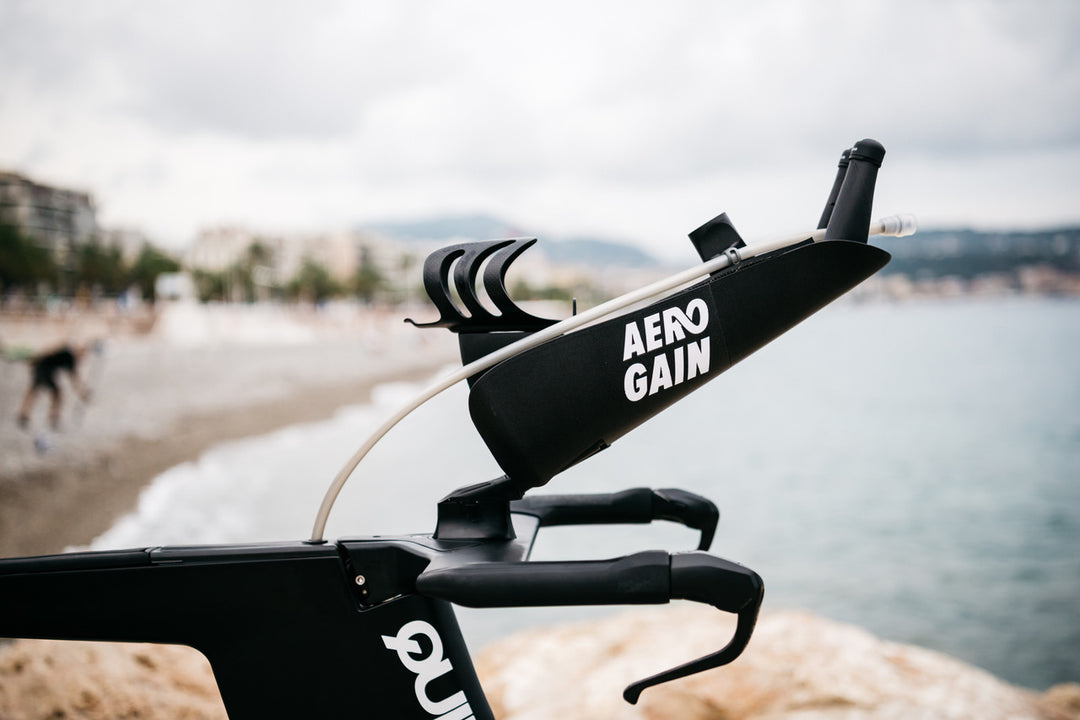
The V2 top section is what makes the system versatile. The top bottle can sit forward between the arms for maximum aero efficiency, or further back closer to the chest, depending on your position and preference. Run one bottle or two on the same mount.
02 — Modular spacer system
Angle-matched spacers at 0°, 10°, 15°, 20°, 25° and 30°. The bottles sit horizontal regardless of your extension angle. Most one-piece BTA mounts don’t adjust at all, so the bottle ends up tilted to whatever angle your bars happen to be at.
03 — Three width fits
Medium (52–148 mm pad-bridge width), Wide (148–198 mm) and Extra Wide (above 198 mm). Covers most tri-bar setups without custom fabrication or filing parts down to fit.
04 — Works with your hydration system
Clamps onto standard pad bridges and aero bars, with a matte black finish, and is compatible with popular hydration systems including the XLAB Torpedo. Your existing armcups do the clamping — no extra brackets, no pad swap.
Take these two measurements before you order
Two measurements determine your exact fit: the angle of your extensions, and the width of your armpad bridge. Get both right and the bottles sit horizontal and centred between your arms.
Match your spacer to your extension angle
Your spacer angle has to match the upward tilt of the whole assembly — mounting bracket and clip-on extensions together, not just the extension. Match the spacer to that angle and the bottles sit level between your arm pads: extensions horizontal (0°) → the 0° spacer; tilted up 20° → the 20° spacer; a steep 30° tilt → the 30° spacer.
Not sure of your angle? Rest your phone’s built-in level tool (Apple’s Measure app, for instance) flat against your extensions to read the exact degree.
Measure your armpad bridge width
Measure from mounting bolt to mounting bolt across your armpad bridge, then pick the matching plate width: Medium 52–148 mm, Wide 148–198 mm, Extra Wide 198–238 mm.
How it mounts
The BTA base plate mounts underneath your existing armrest pads — it is sandwiched directly beneath the armcups, which clamp down and hold the plate firmly in place. No extra brackets, and no swapping your pads: your current armcups do the clamping.
Plate width chart
| Fit | Bolt-to-bolt pad-bridge width |
|---|---|
| Medium | 52–148 mm |
| Wide | 148–198 mm |
| Extra Wide | 198–238 mm |
What’s in the box
One BTA mounting plate, one angled spacer, one top piece and all necessary bolts. Bottle cages and bottles are purchased separately — the mount is compatible with popular hydration systems including the XLAB Torpedo.
Tools and install
Standard allen keys, a few minutes, no special tools. Choose your plate width and spacer angle from the dropdowns above before ordering.
This started as a bottle stuffed down a race suit
We didn’t just theorise this. The aero gain was discovered by accident, used at the highest level of the sport, then banned — and the Aero BTA system is the engineered, legal successor to a technique that already proved itself.
AeroGain founder Kristoffer Visti first experimented with carrying a bottle stuffed down the front of his race suit at the Danish National Championships, discovering the aero benefit by accident — not from a wind tunnel, from racing.
Triathlete Magnus Ditlev used the same technique at the Ironman World Championship in Kona — the same principle, now on the world’s biggest triathlon stage.
World Triathlon and Ironman banned the in-suit technique, for safety and uniformity reasons. The aerodynamic principle wasn’t in question — the method of carrying it was.
The Aero BTA system was developed as the engineered, legal answer — same aerodynamic principle, filling the gap between the arms and chest, now properly mounted instead of stuffed into a suit. V2 takes that one step further: both race bottles in the cockpit, none on the frame.
Built for long-course riders who don’t want a frame bottle
This is for you if
- You race distances where one bottle isn’t enough fluid and you don’t want the second one on the down tube.
- You race on a dedicated TT or triathlon bike with a tri-bar cockpit and pad bridge.
- You want to fine-tune fore-aft bottle position — forward between the arms, or back towards the chest — rather than accept one fixed spot.
- You run a hydration system such as the XLAB Torpedo and want it to fit.
This isn’t for you if
- You ride a road bike with no clip-on aero bars and no pad bridge to clamp onto.
- You only ever run a single bottle up front and want the simpler mount — that’s the Aero BTA system.
- You’re after a rear, behind-the-saddle hydration and storage system — that’s the Aero BTS PRO, a different product.
- You want a one-piece mount and don’t care about angle-matching.
If your cockpit has a pad bridge, you need two bottles, and you care about the number, this is built for exactly that setup.
Fit and installation, answered
The V2 top section is redesigned for versatile bottle positioning. The top bottle can sit forward between the arms for maximum aero efficiency, or further back closer to the chest, and the mount takes one or two bottles. Our 35-athlete velodrome test measured both positions: 8 W median versus no bottles with the top bottle forward, 7.3 W with it further back, against 4.5 W for a single bottle between the arms. So carrying the second bottle up front is worth roughly 3.5 W over running one — and far more than putting it on the frame, which costs 6 W. Choose V2 for two-bottle capacity and fore-aft adjustability; choose the Aero BTA system if you only ever run one bottle.
It clamps onto standard pad bridges and tri-bar systems, in three width fits: Medium (52–148 mm pad-bridge width), Wide (148–198 mm) and Extra Wide (above 198 mm). Measure bolt-to-bolt across your armpad bridge before ordering — the sizing chart is in the setup guide above.
Yes. The system integrates with standard aero cockpits and is compatible with popular hydration systems including the XLAB Torpedo. Bottle cages and bottles are purchased separately.
Yes. The mount takes one or two bottles, so you can run a single bottle for shorter races and add the second for long course without changing hardware.
That’s what the spacers are for. Angle-matched spacers at 0°, 10°, 15°, 20°, 25° and 30° mean you pick the one matching the tilt of your whole extension assembly, and the bottles sit horizontal regardless of your position.
One BTA mounting plate, one angled spacer, one top piece and all necessary bolts. Bottle cages and bottles are purchased separately.
No. It installs with standard allen keys in a few minutes. The base plate goes underneath your existing armrest pads, so your current armcups do the clamping and there is nothing to swap out.
AeroGain’s own velodrome testing at Ballerup Super Arena, Copenhagen — 35 athletes, test speeds between 35 and 50 km/h, reported as power saved at 45 km/h versus riding with no bottles at all. Not a single-rider tunnel run and not a CFD simulation. The double-bottle BTA median was 8 W with the top bottle forward and 7.3 W with it further back; the best measured result was 14 W. Two frame bottles cost an average of 7 W, a median of 6 W, and 12 W in the worst case — so switching is worth a median of 14 W, an average of 15 W, and 26 W at best.
There is a 30-day satisfaction guarantee: return an unused unit in its original condition and packaging for a refund. Confirm your pad-bridge width and extension angle before ordering to avoid a fit mismatch in the first place.
All aero figures from AeroGain in-house velodrome testing at Ballerup Super Arena, Copenhagen: average results of 35 athletes, test speeds between 35 and 50 km/h, baseline CdA between 0.165 and 0.237, reported as power saved at 45 km/h versus riding with no bottles at all. The Aero BTA median saving is 8 W and the best measured result was 14 W. Two 750 ml bottles on the frame cost an average of 7 W and a median of 6 W, with a worst measured case of 12 W. Switching from two frame bottles to the Aero BTA is therefore worth a median of 14 W, an average of 15 W, and 26 W in the best measured case. A single bottle between the arms returns a median of 4.5 W; a double-bottle setup with the top bottle further back returns 7.3 W. Not all riders tested every setup. Individual results vary with rider position, bottle size and yaw. Test conditions available on request. The 8 W median is measured with the top bottle forward between the arms and 7.3 W with it further back; both positions are available on this mount.
Velodrome-tested in Denmark
Both bottles in the cockpit. None on the frame.
Median 8 W saved versus riding with no bottles, and up to 14 W at best. Two frame bottles cost you 6 W more on top — so switching is worth a median of 14 W, an average of 15 W, and 26 W in the best case we measured. One or two bottles, six spacer angles, three plate widths, XLAB Torpedo compatible.
Made and tested in Denmark · Express FedEx shipping · 30-day satisfaction guarantee