
Aero Cockpit from the front three-quarter on a white background
Aero Cockpit fitted to a Specialized S-Works Shiv TT with two aero bottles between the arms
Close view of the Aero Cockpit on a Specialized S-Works Shiv TT, bottles and grips in frame
Two riders holding the aero position on the Aero Cockpit at racing speed
AeroGain Aero Cockpit, the one-piece shell in three-quarter view on a white background
Aero Cockpit seen from above on a white background
A pair of interchangeable AeroGain grips on a white background
AeroGain angled riser pair on a white background, side view
Aero Cockpit fitted to a Scott TT bike, full bike in view
Close view of the Aero Cockpit on a Scott TT bike with two bottles carried between the arms
Aero Cockpit on a Specialized S-Works Shiv TT seen from a wider angle
Aero Cockpit packed in an AeroGain box with a branded cloth bag
Rider in the aero position on the AeroGain Aero Cockpit, forearms closed together on the one-piece surface
Aero Cockpit fitted to a Scott TT bike with two aero bottles carried between the arms
Aero Cockpit body on white, showing the one-piece surface and the extension exits
Underside of the Aero Cockpit showing the rounded profile and the bracket mounting holes
Aero Cockpit bolted to the spacer towers of a Scott TT bike, seen from the side
Interchangeable AeroGain hand grips, removed with two bolts
CNC-machined 7075 aluminium angle brackets, continuously adjustable between 15 and 30 degrees
Aero Cockpit packed in an AeroGain box with a branded cloth bag
Diagram: armpad width measured from the outside edge of the left cup to the outside edge of the right cup
Diagram: reach measured from the front of the basebar to the tip of the extensions
Diagram: forearm length measured from the tip of the elbow bone to the wrist
Step 1 of fitting the Aero Cockpit: the bare riser towers on the bike with nothing fitted yet
Step 2: the lower half of the AeroGain angled riser bolted onto the riser towers
Step 3: the complete angled riser assembled on the towers and set to 22 degrees
Step 4, close up: the Aero Cockpit mounted on the angled risers and torqued down
Aero Cockpit at minimum reach with the risers set to 22 degrees, full cockpit in view
Aero Cockpit at maximum reach with the risers set to 22 degrees, showing the 70 mm reach range
Aero Cockpit at maximum reach with the risers set to 15 degrees, the shallowest angle
Aero Cockpit at maximum reach with the risers set to 30 degrees, the steepest angle

Aero Cockpit

Prix régulier€999,00 EUR
/
TVA incluse. Frais d'expédition calculés lors du passage à la caisse.

Délai d'environ 2 semaines. La première série de production est limitée à 40 cockpits.

  • Dimensionné sur des centaines d'athlètes mesurés — trois tailles, issues de nos réalisations sur mesure
  • Repose-bras profonds, sur lesquels prendre appui : la position tient quand la fatigue arrive
  • 15°–30° d'angle, 70 mm de reach — réhausses angulaires en 7075 usinées CNC incluses
  • Poignées interchangeables — mono ou double, SRAM ou Shimano, deux vis
  • Moins de 1 000 €, réhausses angulaires dans la boîte — l'un des cockpits monocoques les plus compétitifs du marché
  • Expédition internationale en FedEx Express — 1 à 4 jours ouvrés
  • Réhausses angulaires incluses — CNC 7075
  • Express worldwide shipping with FedEx — 1–4 business days
  • 30-day returns
  • 2-year warranty
  • Crash replacement

Complétez votre installation

FedEx ExpressInternational shipping, 1–4 business days
Free shipping in the EUFlat €25 to US, UK, AU, CH & NZ
Angled risers includedCNC 7075, not an upsell
Made in DenmarkPrinted to order

Une partie vélo plus rapide, et des jambes encore valides.

L'aéro ne paie que lorsque vous êtes réellement en position. Une coque monobloc dimensionnée sur des centaines d'athlètes mesurés, sur des réhausses qui se boulonnent directement sur les entretoises de votre vélo — moins de 1 000 €, réhausses incluses.

Valdemar Solok

Training toward Nice

On the Aero Cockpit, ahead of the IM 70.3 World Championship.

Hours on the road, in the position, long before the race that counts.

Highlights — Aero Cockpit

Scroll for more →
Aero Cockpit bolted onto the angled risers on the bike's riser towers
Tower lock

Straight onto your riser tower

Variable angle risers bolt to the towers your extensions already use. No adapter plates and no stacked spacers.

Aero Cockpit at minimum reach, risers at 22 degrees
Reach range

Reach and angle, set on the bike

70 mm of reach and 15–30° of angle, adjusted with the cockpit mounted. Tap through the settings — a fit session, not a reorder.

AeroGain mono grip on a white background
Swap grip

Grips off in two bolts

Mono or double, SRAM blips or wired Shimano. Tap through them — test both instead of guessing, and keep the cockpit when you change groupset.

One-piece Aero Cockpit shell on white
Mono shell

One surface, not two

A continuous carbon-cored shell instead of two armrests with a hole between them. The air stops separating between your forearms.

Rounded underside of the Aero Cockpit
Round flow

The rounded underside

Leads air around the section and holds flow attached for longer — significantly faster than monocoque cockpits built on more angular designs.

Rider braced in the aero position on the cockpit
Brace wall

High sides that work twice

They guide air past the forearms and give you something solid to brace against. Aerodynamic and structural, from one surface.

Aero Cockpit fitted to a TT bike
Fit matrix

Sized on hundreds of athletes

We built custom cockpits first, one athlete at a time. Hundreds of fits later the pattern was clear enough to make three sizes out of it.

Aero Cockpit packed in an AeroGain box inside a velour protective cover
Soft cover

Arrives protected

Delivered in a high-quality velour protective cover inside the AeroGain box, so it reaches you unmarked.

Find your size

Two measurements: one off the bike you ride now, one off your own arm. If you haven’t measured either yet, rider height is a reasonable starting point.

Diagram: armpad width measured from the outside edge of the left cup to the outside edge of the right cup
On your current setup

Armpad width

Outer edge of the left cup to the outer edge of the right cup. This is the outside width — pad width is often quoted centre to centre elsewhere, so measure your current setup the same way before you compare the numbers.

Diagram: forearm length measured from the tip of the elbow bone to the wrist
On you

Forearm length

From the tip of your elbow bone to your wrist.

SizeArmpad widthForearm lengthRider height
S20 cm27 cmUp to 174 cm
M24 cm29 cm175–185 cm
L28 cm31 cm186 cm and over
Between two sizes? Go up, on both.

Height is a starting point, not the rule — the two measurements decide it. Aim for the narrowest width where you can still tuck your shoulders in behind your arms and hold it for your full race distance. Narrower than that and you lose the shoulder tuck, which gives back more than the width saves.

A cup shorter than your forearm leaves the last part of it unsupported, and support along the whole length is the point of the shape. Each size carries 70 mm of reach and 15–30° of angle, so the size sets your width — not your whole position.

If sizing up isn’t a trade you want to make, that is what the Custom Aero Cockpit PRO is for: built to your number rather than the nearest of three.

Easy to mount on all compatible bikes

Shown on a Specialized S-Works Shiv TT. The sequence is the same on every listed frame with two riser towers.

010:05

Strip the front end

Extensions and pads off. This is where you start.

020:10

Risers on

Both halves of the angled riser onto the towers. Mount with a recessed nut and a bolt from beneath, or a bolt from above as in this video.

030:13

Nuts and pole clamps

Nuts seated, then the pole clamps slide onto the cockpit itself.

040:12

Cockpit on, torqued

Down onto the risers and torqued to spec.

050:13

Reach adjusted

70 mm of reach, set with the cockpit mounted.

060:07

Angle adjusted

15° to 30°, also set with the cockpit mounted.

070:09

Cables routed

Through the cockpit and out of the wind.

080:11

BTA spacer and cages

The Aero BTA spacer set and bottle cages mount to the cockpit.

090:18

Grips swapped

Off in two bolts. Mono or double, SRAM blips or wired Shimano.

All components and sizing

Cockpit
ConstructionCarbon fibre core, 3D-printed shell
StructureOne-piece, integrated armcups
SizesS / M / L
Weight645 g — size M, cockpit only
Risers and mounting
Riser materialCNC-machined 7075 aluminium
Angle range15°–30°, continuously adjustable
Fore-aft reach70 mm
InterfaceTwo riser towers
Riser torque6 Nm
Grips and controls
Grip optionsMono · double · narrow · wide · long
Blip compatibilitySRAM eTap AXS · wired Shimano / SRAM
Grip changeTwo bolts
In the box
CockpitIn your size, printed for your frame
Angled risersIncluded
Pole clampsIncluded
GripsYour chosen pair
Computer mountGarmin or Wahoo
PaddingIncluded
Protective coverVelour, inside the box
Lead time, warranty, returns and origin
Lead timeApprox. 2 weeks
First production runLimited to 40 cockpits
Warranty2 years
Returns30 days
Country of originDenmark
Armpad width, outside to outside20 cm
Forearm length, elbow bone to wrist27 cm
Rider height, as a starting pointUp to 174 cm
Reach adjustment70 mm
Angle adjustment15°–30°
Armpad width, outside to outside24 cm
Forearm length, elbow bone to wrist29 cm
Rider height, as a starting point175–185 cm
Weight, cockpit only645 g
Reach adjustment70 mm
Angle adjustment15°–30°
Armpad width, outside to outside28 cm
Forearm length, elbow bone to wrist31 cm
Rider height, as a starting point186 cm and over
Reach adjustment70 mm
Angle adjustment15°–30°

Between two sizes? Go up. A cup shorter than your forearm leaves the end unsupported, and a narrower one is harder to hold for four hours. Measure armpad width outside edge to outside edge — not centre-to-centre. Height is a guide; the two measurements decide it.

Questions fréquentes

S 20 cm, M 24 cm, L 28 cm de largeur extérieure des repose-bras, pour une longueur d'avant-bras de 27 / 29 / 31 cm. Comme point de départ, une taille S convient jusqu'à 174 cm, une M de 175 à 185 cm, et une L à partir de 186 cm — mais ce sont les deux mesures qui décident. Entre deux tailles, prenez la plus grande.

13 plateformes de cadre — ouvrez la liste Modèle de vélo ci-dessus pour les voir. Les cadres dotés de leur propre fixation d'origine, comme les Argon 18 E-series, Cervélo P5 / P5X / P3X, Shiv Disc Tri et Quintana Roo PRSix, sont couverts par le Custom Aero Cockpit PRO à 1 249,90 €. Pour tout autre modèle, écrivez-nous.

Les commandes internationales partent en FedEx Express, 1 à 4 jours ouvrés. Gratuit dans l'UE ; forfait de 25 € vers les États-Unis, le Royaume-Uni, l'Australie, la Suisse et la Nouvelle-Zélande. Le Danemark est livré via Shipmondo. Le coût exact est indiqué au moment du paiement.

Oui. Aluminium 7075 usiné CNC, compris dans les 999 €.

L'Aero Cockpit à votre taille, imprimé en 3D pour votre cadre ; des réhausses angulaires en aluminium 7075 usinées CNC, 15°–30° ; les colliers de serrage qui relient les deux ; les poignées de votre choix ; et un support de compteur, dans une housse de protection en velours. Les systèmes BTA sont à commander séparément.

Même forme, mêmes réhausses angulaires, mêmes poignées. Construit à votre largeur plutôt qu'à la plus proche des trois tailles. 400,90 € de plus.

70 mm de reach et 15–30° d'angle, réglables tous les deux sur le vélo. La largeur, elle, est fixée par la taille que vous choisissez.

Garantie légale de conformité de deux ans, et 30 jours pour retourner le produit.

Nous l'avons construit. Ils ont couru avec.

★★★★★
Le repose-bras mono AeroGain a complètement changé ma position. Il m'a donné la stabilité et le maintien qu'il me fallait pour rester en position aéro plus longtemps — et j'ai senti la différence tout de suite.

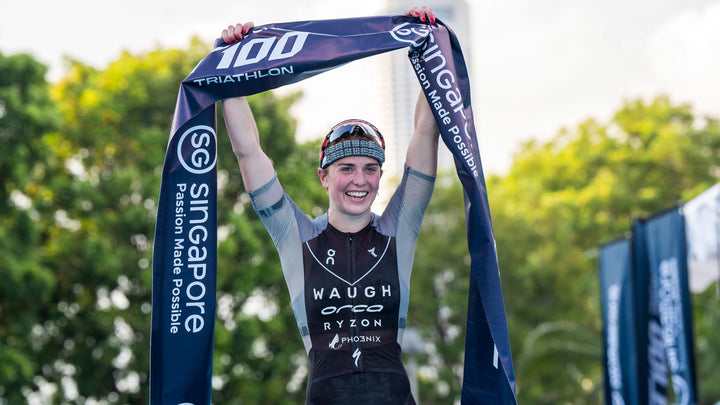
Kate Waugh, championne du T100 Singapour

Two riders in the aero position on AeroGain cockpits, side by side on the road

La configuration la plus rapide est celle que vous utilisez vraiment.

999 €, réhausses angulaires incluses. Trois tailles.

Choisissez votre taille

Vous aimerez aussi